4 Guidelines for Eating Soy and the Surprising Science Behind Them

Last week I had my first plant-based meal prepared for me by a Finnish friend and it was delicious!  We feasted on a veggie stir-fry over rice, creamy spinach and of course, I made some sweet potato fries too (I couldn't help myself).  My friend cooked up some tofu special, just for our meal, but explained how normally, he tries to avoid soy foods.  He's concerned about the hormonal effects it may have on his body.

And he is absolutely not the first person I´ve met who tries to avoid soy.  Another women at a cooking demo of mine and was told by her physician to avoid soy like the plague because she had breast cancer.


What does the totality of research soy about soy?  Do you really need to be worried about eating soybeans?

Here's the outcomes from six different studies:

1.  A meta-analysis found that soy foods and isoflavone supplements do not affect testosterone levels in men.  This review included 15 placebo-controlled trials, and was published in Fertility and Sterility (1).

2.  The consumption of soy foods were associated with a reduction of prostate cancer risk of about 26%.  The consumption of tofu and soy milk was associated with an even lower risk of about 30%.  This study was a meta-analysis which included 14 studies and was published in the Americn Journal of Clinical Nutrition (2).

3.  In this meta-anlysis, the lowest risk of breast cancer was found in people consuming the highest level of soy foods.  This review reviewed eight different studies, and was published in the British Journal of Cancer (3).

4.  Published in the Journal of the American Medical Associationthe Shanghai Breast Cancer Survival Study, found an inverse association between soy food intake and breast cancer mortality and reoccurrence.  In other words, those eating the highest amount of soy had the lowest rates of mortality from breast cancer and breast cancer reoccurrence (4).

5.  The Singapore Chinese Healthy Study found a statistically significant reduction in hip fractures of approximately 30% in women consuming at least 1/4 cup of tofu a day (5).

6.  Amy Lanou, PhD concluded in her review on soy foods and bone health, that soy as part of a dietary pattern, supports bone health, while isolated soy extracts have shown mixed results.  Dr. Lanou analyzed 13 different studies in this review (6).

There's much more that could be said about each of these studies and the 'why' behind whole soy foods having a health promoting effect.   For now, the take home message is... the weight of the evidence supports whole soy foods as being beneficial for breast cancer, prostate cancer, bone health and doesn't affect testosterone levels in men.  So, if you like soy foods, eat them!  

If you want more information on soy and health, here's a PDF from the Physician's Committee for Responisble Medicine.  It references 21 different studies, is easily understandable and you can show it to your doctor if need be.  


So how do you put this information to use in your daily life? 

Here's 'Four Simple Guidelines for Eating Soy Foods.'

1.  Choose whole, soy foods like edamame or soy beans, tofu, soy milk, miso, tempheh or bean curd.

2.  Avoid isolated/processed soy products such as isolated soy protein, hydrolyzed soy protein, highly processed soy burgers, soy bean oil and soy protein shakes. 

3.  Eat soy as a condiment.  About 40% of soy's calories come from fat so don't sit down and munch on tofu chunks and soy foods all day long.  Simply add some tofu to a stir-fry or some soy-milk to your oatmeal.  This way you'll get the nutritional benefits without eating too much fat and extra calories.  

4.  If you hate soy foods, don't eat them!  Although the evidence supports whole, soy foods, you can still eat a health promoting diet without soy.  

Basically, eat soy like an Asian!  Eat whole, soy foods and treat them as condiments.

Now it´s time for you to put this information into action because what is knowledge if you don´t do anything with it?  Useless!

Answer this week´s Take Control Now question and put your answer in the comments section below.

Take Control Now 

What is one plant-based meal that includes a soy food you could enjoy?

If you like this article and video, please share it with your friends and family or have them sign-up for a free resource guide at www.TrishaMandes.com

The Vegan Food NO ONE Should Eat

You might be surprised to hear me say that vegan food sucks.  

This is fake vegan food I’m talking about.  C.R.A.P. food.... calorie rich and processed as Jeff Novick, RD, MS commonly says.  Not the whole plant foods I cherish... potatoes, beans, whole-grains etc.  

C.R.A.P. foods like french fries, corn chips, alternative meats that are highly processed; fake cheese, vegan bar food, mock sour creams, vegan ice-cream bars, fake french onion dip and the list goes on.  

Many people beginning to implement a plant-based diet, will still eat these foods because they're vegan, assuming they're okay or good for your health.

However, these foods are disasterous for your body and won’t help you lose or maintain a healthy weight.  They’ll do just the opposite!

You don't have to be vegan to eat these foods either.  Meat lovers are definetly munching on tortilla chips, french fries (vegan) and other C.R.A.P. foods too.

This is one reason I don’t resonate calling myself vegan -- the term vegan is only defined by what you don’t eat and not at all by what you do eat.  Although I rarely eat animal foods, I’m eating whole plant foods at least 95% of the time and I rarely eat C.R.A.P.!  

The term 'vegan' doesn't differentiate my clean eating habits from the 'junk food vegan' who's eating C.R.A.P. everyday.

When you look at the nutritional profile of most C.R.A.P. foods, they’re even worse for you than animal foods.  However, both the refined C.R.A.P. vegan foods and animal products aren't nearly as health promoting as whole, plant foods.  So this isn't an excuse for you to eat animal foods!  Remember that.

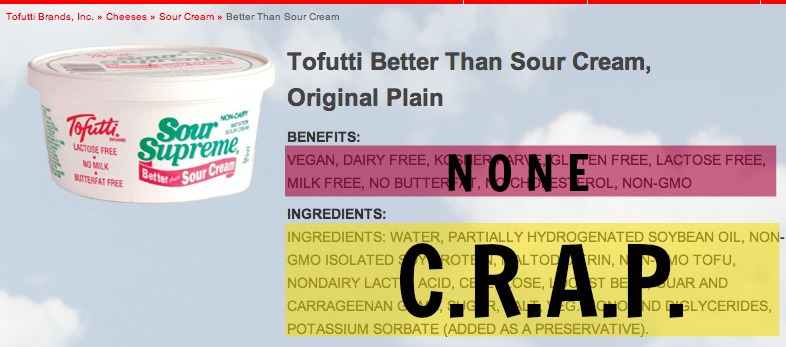
Tofutti's 'Better Than Sour Cream' is an example of how disasterous some vegan C.R.A.P. food can be.  Take a look at the ingredient list.  What whole, plant foods can you identify?

The only whole food in this product is tofu, but who cares!  It's covered in trans fat (which we should not eat any of) and chemicals.  Seventy-five percent of the calories of this 'food' are coming from fat too.  

This food is not good for you!  Even though it's vegan, it's still C.R.A.P.!  

(If you want another example, watch the above video... you'll see what's in the famous 'Boca Burger' and it's not good).

To decipher through the C.R.A.P. always remember...

1.  Vegan doesn't necessarily mean healthy.   

2.  Always read the ingredient list of any product you're buying.  It's the only way you'll know what's in your food.

So stop eating C.R.A.P. my friends and choose whole, plant foods instead!

It’s time for you to put this knowledge into action because what is knowledge if you don't do anything with it?  Useless!  Answer this Take Control Now question and put your answer in the comments section below.  You can answer this question whether you're vegan or not!

Take Control Now

What kind of C.R.A.P. food is currently in your house?  Remove that C.R.A.P. from your house, report back and tell us what you threw out.  

Put your answers in the comments section below.  Awesome job taking action.

How Faith Lost 20 lbs. in 7 weeks

I got an exciting email last week from a new friend. Faith Clemente, mother of two, is part of the TrishaMandes.com community.  She wrote to tell me that she lost 20 lbs in less than seven weeks and dropped three pant sizes!  All without calorie counting or portion control.  Yeah Faith!  

How did Faith do this?  She simply took advantage of the FREE resource guide she received for signing up for email updates on www.TrishaMandes.com.  Then, she read the books, watched the movies, used the recipes and voila!  When you dive into the diet and completely go for it, you can expect to lose 1-3 lbs. each week, just like Faith.

Below is the email Faith sent me describing her experience.  It is a beautiful and inspirational story.

Trisha, 

I hope you are loving your time abroad! Thank you for continuing your support and "Take Control Tuesdays" while you are a away. 

I started my WFPB lifestyle on January 19, 2014 cold turkey. Almost 2 months into it, I have gone down 3 pant sizes. I no longer weigh myself on a regular basis although I did today to let you know I have lost 20 lbs! I am loving it.

My palate has changed to what I believe to be more refined. Food pops in my mouth whether it be earthy (I love mushrooms), buttery (cashew salad dressing) tangy, sweet, bold, etc. Everything tastes amazing. I feel great, I am looking great, my skin has a glow to it, people are starting to notice my weight loss, my house smells like a produce department (that might sound weird but I have noticed it no longer has a slight smell of cooked meat and oil), I have energy after every meal instead of feeling sluggish, and my goal is to live to be at least 100 vibrant and happy! 

My husband has been wonderful through my lifestyle change as well. He is super supportive, eats what I cook, and has even come up with a few recipes himself that follow the WFPB guidelines. On days when he wants something for lunch that we don't have in the house he chooses a healthier option than a fast food cheeseburger. In fact he just discovered he loves sushi. 

I still have lots to learn and a ton of "re-teaching" myself about nutrition.  After looking at your recommended reading list I have read Dr. McDougall's book about weight loss, Dr. Fuhrman's Eat to Live, and the Forks Over Knives book after rewatching the film on netflix.

My husband and I watched it almost 2 years ago and even went out and bought the Forks over Knives cookbook. I didn't make a single recipe out of it until last fall when I had my vegan sister and brother-in-law over for dinner. The recipes in those four books have been my food bible. They have helped me with the basics of cooking this way and understanding why meat, dairy and oils are not good for you foods. I have just ordered 4 new cookbooks for WFPB eating! I can't wait to dive into those!

I have also learned that the vegan diet isn't as great as I assumed it was. There is so much processed food and chemicals that go along with that diet. Have you ever read the ingredients on fake cheese? Gross! Earth Balance, Vegenaise, Tofutii... I don't even know how to spell them they are so fake LOL.

My next step is to start exercising on a regular basis. It is difficult to find time when I have 2 boys under the age of 3. It's not impossible but difficult.  

I've said it before and will many times more; thank you Trisha for your passion and inspiration to help people live longer healthier lives. If it wasn't for you I would never have picked up my first book to learn the benefits of living whole food and plant based. 

- Faith C., 29 yeas old, Legal Secretary, Newberg, OR, Mother of two

I'd like to thank Faith for sharing her story with us.   She is an inspiration and is doing an amazing job!  We will keep in touch with Faith and let you know how she progresses.

Take Control Now

Would you 'jump right in' to a plant-based diet like Faith, or would you take smaller, more transitional steps?

Answer in the comments section below.  

Why "Eating Less" is NOT the Answer to Weight Loss

Dr. Doug Lisle explains why "eating less" is not the answer in his one hour lecture titled 'How to Lose Weight Without Losing Your Mind.'  Dr. Lisle is a Clinical Psychologist and the Director of Research at the True North Health Center in California.  He is also the co-author of the amazing book 'The Pleasure Trap.'  

He explains how skinny people aren't any 'less indulgent' than those with excess weight; how humans are one of the three animals on the planet that can't control their weight and the number one reason you aren't losing weight.  It all boils down to one thing... 

...the natural law of satiety is being broken.  

What's the law of satiety?

In our digestive system, we have nutrient and stretch receptors.  Nutrient receptors calculate how much nutrition is in our food.  I.e. calories, fat, protein and carbohydrate.  Stretch receptors decipher how much volume of food has been eaten.  When both the nutrient and stretch receptors become appropritely activated, our digestive system will tell our brain it's time to stop eating.  If we don't, it will become painful.

The receptors have been appropriately activated when 1.  there’s enough food our stomachs (or bulk) and 2. when we’ve eaten enough nutrition -- calories and macronutrients.  

If we don't get enough of one or another, we still won't feel satisfied.  Dr. Lisle uses the example of lettuce.  If you eat one pound of lettuce, you won't feel satisfied and full even though you've eaten a large quantity of food.  This is because the lettuce is so low in calories (around 100 calories/pound) that it's not enough nutrition for the nutrition receptors to be satisfied.  Likewise, if you eat a high calorie food, like chocolate for example, that doesn't have a lot of volume to it, you won't feel full even if you're eating enough calories.  

This is the law of satiety and this natural law is being broken everyday by humans, causing most of us to gain weight.  The hyper-concentrated foods the average American is eating (refined foods and animal products.  Only 6% American's diets come from unrefined plant food) is tricking our nutrient and stretch receptors.  Our bodies think we haven't eaten as many calories as we really have because the volume of these hyper-concentrated foods is small compared to how many calories they contain.  

As an example, Dr. Lisle asks what will fill you up more?  Two cups of ice-cream or, 1/2 gallon of salad, 3 ears of corn, 2 baked potatoes and a pound of cherries?  Same amount of calories, but the latter, is made of whole, plant foods that are naturally low in calories, but large in bulk.  

Skinny people aren't any less indulgent than fat people

There's a false assumption that those with excess weight are what Dr. Lisle calls, "eating into the pain."  They're eating so much until it hurts, everyday.  However, this isn't true!  

According to Dr. Lisle, women in the U.S. gain on average, one pound every year from the age of 20 to 40.  That equals only 10 extra calories per day.  Large people aren't massively overeating and they aren't massively out of control.  Rather, their nutrient and density receptors have been fooled.  

Skinny people have escaped this problem not because of their will-power, or because they are smarter or are in more control than bigger people, but because their genetics have given them more nutrient and stretch receptors.  This allows them to become fuller on less calories making it easier for them to not gain weight.  Unfortunately, skinny people eating the typical American diet, won't escape from other nutritional diseases like heart disease or cancer from eating this way.  

Think you've tried everything and nothing works?

If you think you’ve tried EVERYTHING... you’ve tried every diet there is and nothing works.  Or, you just eat 'healthy' and are still over weight, I want you to answer yes or no to these questions...

Have you ever followed the dietary advice of any of these doctors... Dr. Caldwell Esselstyn, Dr. Neal Barnard, Dr. Joel Fuhrman, T Colin Campbell PhD, Pam Popper PhD, ND,  Dr. John McDougall, Doug Lisle PhD, or Dr. Alan Goldhamer? 

If you answered no, then you haven’t tried what myself and these amazing docs recommend.  If you answered no, then you have not tried everything and you are not doomed to deal with excess weight.  If you answred no, your stomach is being fooled from the foods in your diet and for the average person, it’s going to be difficult to maintain a healthy weight.  

Getting the weight off is easier than you think!  Just swap one hyper-concentrated food, for an unconcentrated one and you'll lose weight.  Want to lose even more?  Swap more foods!  Need help doing this?  That's what I'm here for.  Contact me with any questions and I'll make sure you get results right away.

Take Control Now

Have you ever followed the dietary advice of any of these plant-based docs?  What has your experience been dieting before, on or off a plant-based diet?

Put your answers in the comments section below.  

Why Surgery + Meds Won't Save Your Heart

You probably know someone with heart disease or someone whose died from it.  My grandmother died when she was just 52 from a heart attack.  She didn't even make it to my first birthday.  My grandfather -- congestive heart failure.

Many people feel a naive sense of security when diagnosed with heart disease, high cholesterol or blood pressure.  Why?  Because there's "medication and surgery that will save you!"  For most people, that's just WRONG!

Even with technologically advanced surgeries and new medications, heart disease still kills 385,000 Americans annually, while another 715,000 Americans have a heart attack each year (1).

Dr. Caldwell Esselstyn Jr, internationally renowned clinician at the Cleveland Clinic, writes how currently modern cardiology is a complete failure, in an article published in the American Journal of Cardiology.

Esselstyn cites Forrester, JS when he writes... "modern cardiology has given up on curing heart disease.  Its aggressive interventions -- coronary artery bypass graft, atherectomy, angioplasty and stunting -- do not reduce the frequency of new heart attacks or prolong survival except in small subsets of patients" (2).

Modern cardiology is treating the symptoms of disease -- pain and high biomarkers, not the underlying cause of the disease which is from diet and lifestyle.  As Dr. McDougall commonly says, "it's the food!"

It's important you understand there are other means for treating heart disease other than risky surgery and expensive medication.  Dr. Caldwell Essestyn Jr. and Dr. Dean Ornish have both stopped the progression of and reversed heart disease via diet and lifestyle changes (2), (3).  

Unfortunately, your doctor probably won't present this research as a viable treatment option to you.  Likewise, your doctor probably won't advocate for your cholesterol to be below 150 mg/dL (3.9 mmol/L) which was the goal of Esselstyn's patients.

Esselstyn notes in his article (citing Castelli) that "in the Framingham study, people with cholesterol between 150 and 200 mg/dL accounted for 35%  of those with coronary heart disease."  

You can still have heart disease with a 'good' cholesterol level of less than 200 mg/dL advocated by your doctor and the American Heart Association! (4)

Esselstyn continues to cite Castelli stating that "amongst those with levels <150 mg/dL, heart disease was rarely encountered" (2).

If you're interested in lowering your cholesterol levels via diet and are looking for support from your doctor, here is a PDF from the Phycisian's Committee for Responsible Medicine that you can take to share with your doctor.  It references Dr. Ornish's work and gives you practical tips for lowering your cholesterol levels.

Too many doctors are either unaware of this information or just aren't informing their patients.  But it's important you know you have options.  And if you need support and guidance through the transition, I am always here to help.

Take Control Now

Is your total cholesterol above or below 150 mg/dL or 3.9 mmol/L?  

Now is the time to find out and put your answer in the comments section below!

1.  CDC.  Heart Disease Facts. August 2013.  Accessed online Feb. 2014.  

2.  Esselstyn, CB Jr. Updating a 12-Year Experience with Arrest and Reversal Therapy for Coronary Heart Disease (An Overdue Requiem for Palliative Cardiology. American Journal of Cardiology. 1999: 81; August 1 339-341.  

3. Ornish D et al. Intensive lifestyle changes for coronary heart disease. Journal of the American Medical Association. 1998 Dec 16;280(23):2001-7.

4. American Heart Association. What your cholesterol levels mean.  Dec. 2012. Accessed online Feb. 2014.